Tuesday, March 26, 2013

Human Variation


I chose to go with heat as my environmental stresses that negatively impacts our survival as humans. There are many different ways heat affects out homeostasis, whether it is dehydration to a fatal heat stroke. We as humans have had many different adaptations that help us with heat problems. The first being a short term adaptation which would be sweating through our pores, which then cools our body do
wn and brings our  temperature down. A facultative adaptation humans have is very similar to a short term adaptation except it takes a little longer to begin. An example of this would be skin darkening which allows them to not overheat as fast as someone who is lighter skin color who then gets hot quicker and dehydrates faster. A developmental adaptation example is humans body shape of populations who live in higher heat areas tend to have phenotype which allow them to be skinnier. Someone who is skinnier is less likely to overheat because they don’t need to carry a lot of heat in their cores. A cultural adaptation example is mainly the type of clothes we wear, usually in the times with high heat levels humans tend to wear tank tops, shorts, hats, bathing suits, and they also carry around water bottles and drinks that keep them hydrated.

The main benefit of studying human variation is so that when other environmental clines are affected one day which they most likely will be they have the knowledge of what to do to help them. Having the information of all different types of human variation can prevent many different health problems. One example of how that information can be used productively would be when parts of the world start to become hotter due to global warming they can look back on different ways to survive the heat and healthy ways to do so.

I couldn’t really use race to understand the variation of the adaptations because race really wouldn't be able to help me understand variations of adaptations. Race is a class of people who have the same common history, or nationality. But by trying to understand variation by race you are going by the environment which is the main focus. Instead by using environmental influences on adaptations to understand variation would be easier because it is based solely on the environment in which a human lives in. 


Sunday, March 17, 2013

Language Blog


In part 1 of my assignment. I was asked to engage in a conversation for 15 minutes where I was not allowed to use any version of symbolic language, which means I couldn't speak, write or use sign language. This was a very difficult task for me. I like to talk a lot in general so having to not speak for 15 minutes was hard enough. But what was difficult about this is that I couldn't use words it was almost as if I was playing charades. My partners seemed to not alter their ways of communicating to me but rather they made their communication to me more detailed. I think they started doing this so that I would be able to communicate back easier without having to speak. They started to get frustrated, and I know it must have been difficult because they were trying to understand what I was telling them, while not knowing if they were right or wrong. If  both me and my partners where two different cultures, who just met for the first time, I think that the speaking culture has the advantage in communicating complex ideas rather then the one who can’t speak.  The attitude that the speaking culture may have towards the culture who doesn't use symbolic language is that they may feel that they are more intelligent and better off. People in our culture who have a difficulty communication with spoken language may be people who are def, mental ill, or even mute. This has a huge affect on interaction with others because it puts a sense of difficulty in communication, but most of the time while it may be difficult to understand usually you are able to still interact or if needed find a solution.

In Part 2 of my assignment, I was asked to spend 15 minutes communication without any physical embellishments which means no hand signals, not vocal intonation, not head, facial, or body movements. I found this even more difficult then the first part of this assignment. When I speak I always talk at different tones of voice, and use a lot of hand signals. Some would say this is because of my Italian Culture and that is part of who I am. Which is very possible. My partner was affected a lot in this experiment because first off she is not used to me speaking that way, and second off it was as if I had no emotion or feeling involved at all. This experiment shows how much some or most people depend on the use of “signs” in our communication. Being able to use non-speech ways of communication is very important because it shows meaning, emotion, and is easier to understand because it has those traits. There are many people who struggle with the difficulty of reading body language correctly. Some may take certain body language the wrong way and because of that their communication with that person may be affected largely. In general being able to read body language effectively is a great benefit to have. By doing this you can understand the person more and how they are trying to communicate with others. A benefit of not being able to read body language is that you are solely only focused on what they are saying and that’s it.  
Overall this was a great experiment and I learned a lot from it. You really don't understand how symbolic language and physical language are very important to being able to communicate with others 

Monday, March 4, 2013

The Piltdown Hoax


The Piltdown hoax was a hoax that took place in 1912. In an English village named Piltdown. Charles Dawson an Archaeologist and Arthur Woodward geologist claimed they had found a skull and jaw of a human ancestor who lived from 500,000 to 1 million years ago. This jaw bone was claimed to be the missing link between ape and man. This was a big discovery for the scientific community, and Dawson was credited with the fame.  Some scientists didn't believe that there findings were real but they couldn't challenge Woodward’s opinion.  This hoax was discovered false when a few years later, findings of ancient remains of human ancestors who lived hundreds of thousands of years after the Piltdown man were found in Asian and Africa, this didn’t match up to the Piltdown man because their skulls were less human and not more human. This brought many questions to if the Piltdown man was real. In 1949 scientists put the fossils to many test and the result was that the fossils were up to 100,000 years old. After more test they found that the fossils were stained and cut to try to add age to the fossils. The teeth that were on the fossils were even filed down.  After more and more test they came to find that the jaw bone was only 100 years old and was actually a jaw bone of an orangutan.
The human fault that came into play with this hoax was that Charles Dawson wanted to become a famous scientist that was known for a great finding. He wanted to be accepted by fellow scientists.  This was very negative to the scientific process because it now was clear that scientist can forge fossils to have great findings.  The positive aspects of the scientific process that revealed the Piltdown man as a fraud was the tests that were given. The fluorine test was the first step that showed scientists that this “man” was not who they thought it was. After that scientist then gave this Piltdown man a full analysts, they looked under the microscope at the teeth and found they were filed down to look like human teeth and the jaw bone was cut so that they had no proof if it really belonged to the fossils skull that was found with it. I don’t think it’s possible to remove the human factor from science. The human factor will always be there and that is what science needs. It needs scientist who will question one another’s work and even their own findings.  I would never want to remove the human factor from science because no machine will ever be able to replace a humans brain. Humans have great findings each day and always will because we have an unlimited thought process because we are always thinking of different things and what is going on. The lesson I take from this event is that scientific findings can be forged and with that they should always be verified by other scientist who are impartial to the findings. Also that by having this event occur it brought the idea to scientists that other findings can and will be forged and they need to beware of that. 

Wednesday, February 27, 2013

Comparative Primate


Lemurs
1) Lemurs normal habitat is Madagascar; this is an island in the Indian Ocean that is about 250 miles to the west of South Africa. Madagascar is mainly rainforest and in the rain forest it is usually humid and has a lot of plants.
2) My trait is Sociality and Matting Patterns. The social patterns of lemurs are usually they are found in groups from 11-17. With a few being high ranked leaders. The reproduction process of lemurs tend to be based on the environmental conditions.
3) The environmental factor of lemurs to mate only in certain seasons is that they depend on the environment around them. They make sure that they have shelter and enough food and water. This is may be viewed as a adaption because they breed sometimes earlier in age or older.
4)
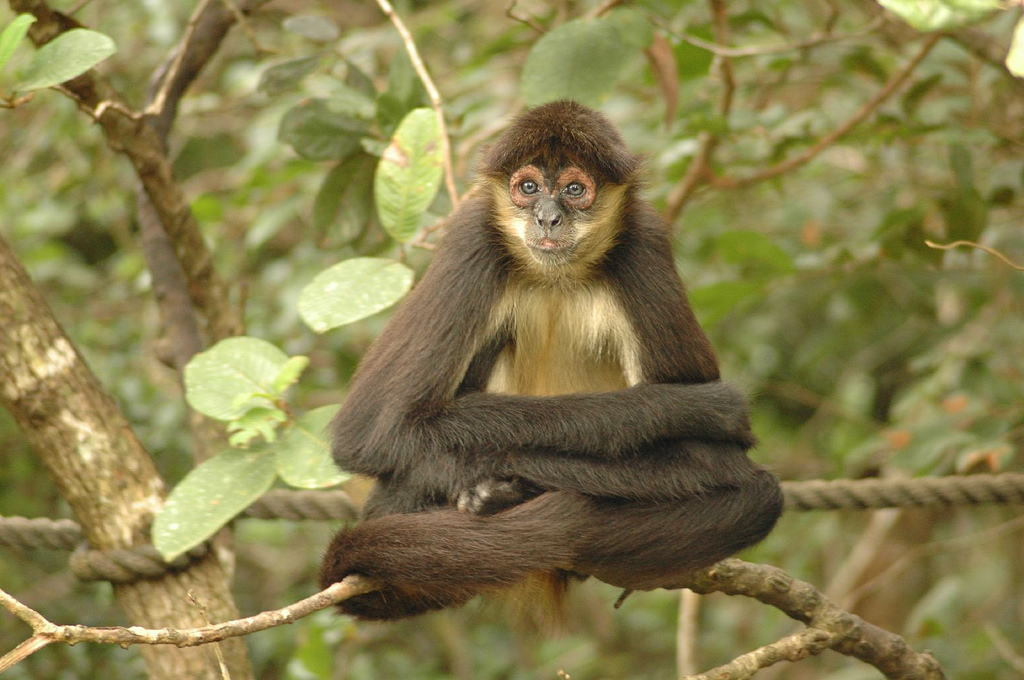
Spider Monkey
1)  Spider Monkeys tend to reside in northern South America. They are found in the rainforests where there is a lot of high trees, here they can capture their food and stay hidden from predators. They are fast from jumping tree to tree.
2)      The social system of spider monkeys lives in fairly large size groups. The tend to feed together and gather fruit and other food items together. During times of less food they spilt into smaller sub groups. The mating of spider monkeys is high. They have a higher reproduction rate than most monkeys and tend to have sexual receptivity lasting up to 10 days.
3)      A trait that can be viewed as an adaptation to the primate’s environment is how they travel in large groups and stay high up in trees. They are fast animals in high up trees because of their capability of jumping. This keeps them away from predators.
44)

Baboons
1)Baboons typically live in Africa or Arabia they usually live in savanna or other arid habitats, some however live in tropical forests.
2) Baboons social patterns consist of them traveling in very large packs of usually 40 or more. They have usually 1 leader who is a female. They breed throughout all seasons and usually there is more females in a group then males.
3)A trait that can be viewed as an adaptation to the primate’s environment is how they travel in such large packs. But when they go out for food they have smaller gathering parties which they gather whatever they can.
4)

Gibbon
1)      Gibbons usually live in old growth tropical rain forests that tend to be in Southeast Asia.
2)      Gibbons social patterns consist of them being very social animals who are very active during much of the say. They tend to travel and live in small groups. There matting patterns are very interesting they usually pick one mate and they stay with them for life.
3)      A trait that can be viewed as an adaptation to the primate’s environment is how they travel in small groups and have only one mating pattern this keeps them very close and watch each other’s back.
4)       
Chimpanzee
1)      Chimpanzees tend to live in a very different variety of places. Usually rain forests, woodlands, swamps, or grasslands that tend to be in West Africa.
2)      The social patterns of chimpanzees are very social animals that are very active during the day. They live in small very structured groups of about 50 members. They also have smaller sub groups of about 7 who stay loyal to each other.  The matting patterns of these animals are that they breed year round.
3)      A trait that can be viewed as an adaptation to the primate’s environment is how they travel in large packs this ensures safe shelter and more of them can gather food for the community. 


Work Cited
http://pin.primate.wisc.edu/factsheets/

Thursday, February 21, 2013

Analogy/Homology Blog Post

a.       Briefly describe the two different species that possess the homologous trait. (5 pts)
Two species that possess the same homologous trait are Whales and Humans. The bones in the human arm are homologous to the bones that are in the front fin of whales. They may be different sizes and they may have different uses for each but they are homologous traits.
b. Describe the homologus trait of each species, focusing on the differences in structure and
function of the trait. Why do these homologus traits exhibit differences between the two
species? Make sure your explanation is clear and complete. (10 pts)
The trait of bones is homologous in both a human and whale. They both have an arm or fin, a whales fin is circle shaped and round with 5 fingers at the end. The human arm is very long and also has 5 fingers. They both have a skeletal structure that gives them the homologous trait. They both have metacarpal bones, radius, ulna, carpal bones and phalanges.
c. Who was (generally, not specifically) the common ancestor of these two species and how do
you know that ancestor possessed this homologus trait? (5 pts)
The common ancestor could be a monkey or even a dinosaur. They possessed this trait because there is evidence like fossils to prove it.
d. Provide an image of each species in this comparison. (5 pts)


a.       Briefly describe the two different species that possess the analogous trait. (5 pts)
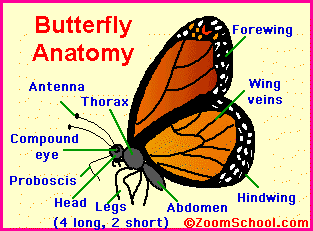
Bats have wings that they use differently than those of butterflies who also have wings.
b. Describe the analogous trait of each species, focusing on the similarities in structure and
function of the trait. Clearly explain why these analogous traits exhibit similarities between
the two species. (10 pts)
Bats and butterflies have analogous traits of wings. Both use these traits so that they can survive by flying away from predators, getting food, or going to a destination to breed.
c. All pairs of organisms share some common ancestor if you go back far enough in time. Did
the common ancestor of these two species possess this analogous trait? Why or why not? (5
pts)
This too species may have shared a common ancestor very far back in time. The reason being is that a bat has a skeleton structure while the butterfly on the other hand is an insect.
d. Provide an image of each species in this comparison. (5 pts)

Thursday, February 14, 2013

Wednesday, February 6, 2013

Who Helped Darwin's Theory? Georges Cuvier

I went onto the Website http://www.pbs.org/wgbh/evolution/library/02/1/l_021_01.html

After reading what they had to say about Georges Cuvier, I believe that he brought a lot of information and evidence that really helped Darwin's Theory of Evolution. During his course of finding information and rebuilding fossils he found evidence of events that put specific species into extinction, yet he believed that the old species that lived were not just put into extinction but they were replaced (evolved) into different species that are on the Earth today.

The bullet point: Individuals do not evolve. Populations do. Individuals cannot change their heritable traits; they can only pass them on. Evolution does not occur within a generation. It occurs between
generations.
Georges Cuvier supported this point on how evolution works. During his course of finding evidence he came to a conclusion that certain species died off and fell into extinction. But a different generation of that type of species was replaced. He didn't know yet but he found that evolution doesn't occur during the like of a species but it occurs from generation to generation.


Could Darwin have developed his theory of natural selection without the influence and ideas of this
individual?

Darwin still might have been able to develop his theory of natural selection, yet Cuvier's information and theory's definitively help Darwin throughout his life. All of Cuvier's information and facts helped Darwin create his theory and gave a lot of evidence to show that he may be right.


How did the attitude of the church affect Darwin and his eventual publication of his book On the
Origin of Species?
Some church goers or religious people actually believed in what Darwin had to say. They believed that God himself made the world to be that way. While other religious believers were against what Darwin had to say, they thought that he was acting out against God and their beliefs and what he had to say was immoral and wrong, Never the less some were with Darwin while many others were not.