b. Describe the homologus trait of each species, focusing on
the differences in structure and
function of the trait. Why do these homologus traits exhibit
differences between the two
species? Make sure your explanation is clear and complete.
(10 pts)
The trait of bones is homologous in both a human and whale.
They both have an arm or fin, a whales fin is circle shaped and round with 5 fingers
at the end. The human arm is very long and also has 5 fingers. They both have a
skeletal structure that gives them the homologous trait. They both have
metacarpal bones, radius, ulna, carpal bones and phalanges.
c. Who was (generally, not specifically) the common ancestor
of these two species and how do
you know that ancestor possessed this homologus trait? (5
pts)
The common ancestor could be a monkey or even a dinosaur.
They possessed this trait because there is evidence like fossils to prove it.
d. Provide an image of each species in this comparison. (5
pts)
a.
Briefly describe the two different species that
possess the analogous trait. (5 pts)
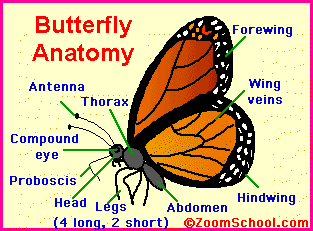
Bats have wings that they use differently than those of
butterflies who also have wings.
b. Describe the analogous trait of each species, focusing on
the similarities in structure and
function of the trait. Clearly explain why these analogous
traits exhibit similarities between
the two species. (10 pts)
Bats and butterflies have analogous traits of wings. Both
use these traits so that they can survive by flying away from predators,
getting food, or going to a destination to breed.
c. All pairs of organisms share some common ancestor if you
go back far enough in time. Did
the common ancestor of these two species possess this
analogous trait? Why or why not? (5
pts)
This too species may have shared a common ancestor very far
back in time. The reason being is that a bat has a skeleton structure while the
butterfly on the other hand is an insect.
d. Provide an image of each species in this comparison. (5
pts)


Good choice for your homologous comparison. You identify the similarities, but remember that it is the differences that tell us about the environmental stresses that produced the variations in the trait. Both humans and whales have similar skeletal structure, but when there are difference, why are they there? Why does a whale fin look as it does compared to the human arm?
ReplyDeleteWith regard to ancestry, "monkeys", or perhaps early primates, gave rise to other primates, not whales, so that isn't a possibility. Reptiles are more distant common ancestors but you don't have to go back that far. Both humans and whales are mammals, so we know that the common ancestor was also a mammal who possessed this similar structure and passed it on to both species.
The issue of ancestry is difficult on your analogous comparison because the common ancestor did occur so long ago, but we know that bats developed wings after mammals split from reptiles, long after the bat-butterfly split. That means the bat evolved the wings independent of that common ancestor, which makes this an analogous trait.