Wednesday, February 27, 2013

Comparative Primate


Lemurs
1) Lemurs normal habitat is Madagascar; this is an island in the Indian Ocean that is about 250 miles to the west of South Africa. Madagascar is mainly rainforest and in the rain forest it is usually humid and has a lot of plants.
2) My trait is Sociality and Matting Patterns. The social patterns of lemurs are usually they are found in groups from 11-17. With a few being high ranked leaders. The reproduction process of lemurs tend to be based on the environmental conditions.
3) The environmental factor of lemurs to mate only in certain seasons is that they depend on the environment around them. They make sure that they have shelter and enough food and water. This is may be viewed as a adaption because they breed sometimes earlier in age or older.
4)
Spider Monkey
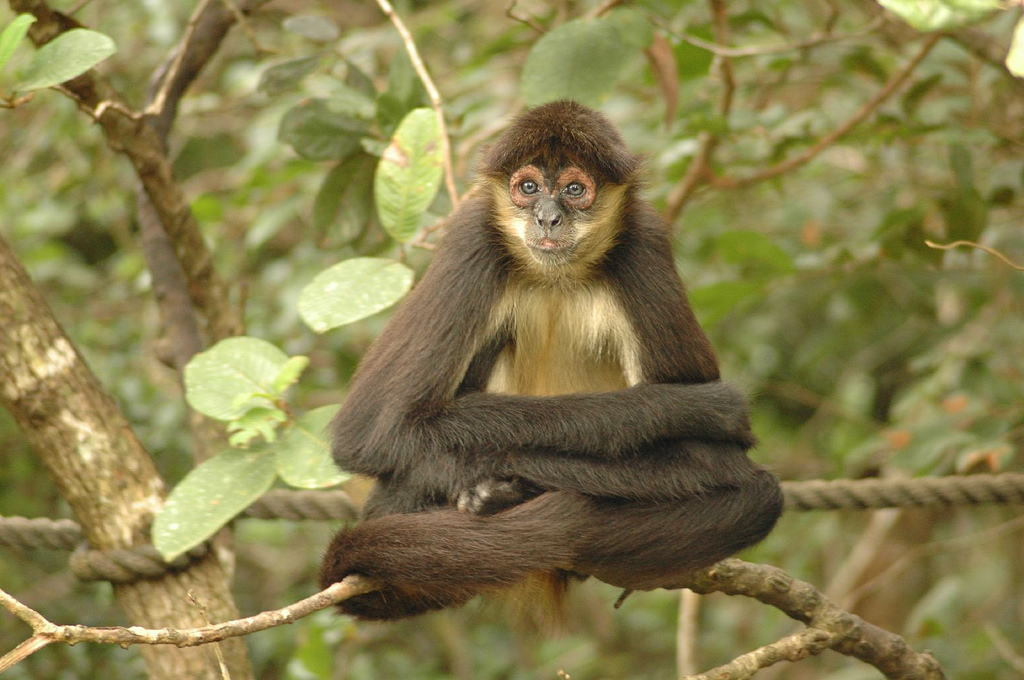
1)  Spider Monkeys tend to reside in northern South America. They are found in the rainforests where there is a lot of high trees, here they can capture their food and stay hidden from predators. They are fast from jumping tree to tree.
2)      The social system of spider monkeys lives in fairly large size groups. The tend to feed together and gather fruit and other food items together. During times of less food they spilt into smaller sub groups. The mating of spider monkeys is high. They have a higher reproduction rate than most monkeys and tend to have sexual receptivity lasting up to 10 days.
3)      A trait that can be viewed as an adaptation to the primate’s environment is how they travel in large groups and stay high up in trees. They are fast animals in high up trees because of their capability of jumping. This keeps them away from predators.
44)

Baboons
1)Baboons typically live in Africa or Arabia they usually live in savanna or other arid habitats, some however live in tropical forests.
2) Baboons social patterns consist of them traveling in very large packs of usually 40 or more. They have usually 1 leader who is a female. They breed throughout all seasons and usually there is more females in a group then males.
3)A trait that can be viewed as an adaptation to the primate’s environment is how they travel in such large packs. But when they go out for food they have smaller gathering parties which they gather whatever they can.
4)

Gibbon
1)      Gibbons usually live in old growth tropical rain forests that tend to be in Southeast Asia.
2)      Gibbons social patterns consist of them being very social animals who are very active during much of the say. They tend to travel and live in small groups. There matting patterns are very interesting they usually pick one mate and they stay with them for life.
3)      A trait that can be viewed as an adaptation to the primate’s environment is how they travel in small groups and have only one mating pattern this keeps them very close and watch each other’s back.
4)       
Chimpanzee
1)      Chimpanzees tend to live in a very different variety of places. Usually rain forests, woodlands, swamps, or grasslands that tend to be in West Africa.
2)      The social patterns of chimpanzees are very social animals that are very active during the day. They live in small very structured groups of about 50 members. They also have smaller sub groups of about 7 who stay loyal to each other.  The matting patterns of these animals are that they breed year round.
3)      A trait that can be viewed as an adaptation to the primate’s environment is how they travel in large packs this ensures safe shelter and more of them can gather food for the community. 


Work Cited
http://pin.primate.wisc.edu/factsheets/

Thursday, February 21, 2013

Analogy/Homology Blog Post

a.       Briefly describe the two different species that possess the homologous trait. (5 pts)
Two species that possess the same homologous trait are Whales and Humans. The bones in the human arm are homologous to the bones that are in the front fin of whales. They may be different sizes and they may have different uses for each but they are homologous traits.
b. Describe the homologus trait of each species, focusing on the differences in structure and
function of the trait. Why do these homologus traits exhibit differences between the two
species? Make sure your explanation is clear and complete. (10 pts)
The trait of bones is homologous in both a human and whale. They both have an arm or fin, a whales fin is circle shaped and round with 5 fingers at the end. The human arm is very long and also has 5 fingers. They both have a skeletal structure that gives them the homologous trait. They both have metacarpal bones, radius, ulna, carpal bones and phalanges.
c. Who was (generally, not specifically) the common ancestor of these two species and how do
you know that ancestor possessed this homologus trait? (5 pts)
The common ancestor could be a monkey or even a dinosaur. They possessed this trait because there is evidence like fossils to prove it.
d. Provide an image of each species in this comparison. (5 pts)


a.       Briefly describe the two different species that possess the analogous trait. (5 pts)
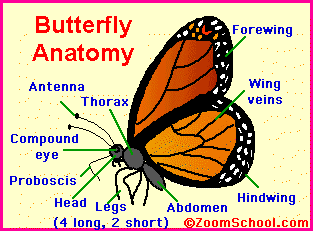
Bats have wings that they use differently than those of butterflies who also have wings.
b. Describe the analogous trait of each species, focusing on the similarities in structure and
function of the trait. Clearly explain why these analogous traits exhibit similarities between
the two species. (10 pts)
Bats and butterflies have analogous traits of wings. Both use these traits so that they can survive by flying away from predators, getting food, or going to a destination to breed.
c. All pairs of organisms share some common ancestor if you go back far enough in time. Did
the common ancestor of these two species possess this analogous trait? Why or why not? (5
pts)
This too species may have shared a common ancestor very far back in time. The reason being is that a bat has a skeleton structure while the butterfly on the other hand is an insect.
d. Provide an image of each species in this comparison. (5 pts)

Thursday, February 14, 2013

Wednesday, February 6, 2013

Who Helped Darwin's Theory? Georges Cuvier

I went onto the Website http://www.pbs.org/wgbh/evolution/library/02/1/l_021_01.html

After reading what they had to say about Georges Cuvier, I believe that he brought a lot of information and evidence that really helped Darwin's Theory of Evolution. During his course of finding information and rebuilding fossils he found evidence of events that put specific species into extinction, yet he believed that the old species that lived were not just put into extinction but they were replaced (evolved) into different species that are on the Earth today.

The bullet point: Individuals do not evolve. Populations do. Individuals cannot change their heritable traits; they can only pass them on. Evolution does not occur within a generation. It occurs between
generations.
Georges Cuvier supported this point on how evolution works. During his course of finding evidence he came to a conclusion that certain species died off and fell into extinction. But a different generation of that type of species was replaced. He didn't know yet but he found that evolution doesn't occur during the like of a species but it occurs from generation to generation.


Could Darwin have developed his theory of natural selection without the influence and ideas of this
individual?

Darwin still might have been able to develop his theory of natural selection, yet Cuvier's information and theory's definitively help Darwin throughout his life. All of Cuvier's information and facts helped Darwin create his theory and gave a lot of evidence to show that he may be right.


How did the attitude of the church affect Darwin and his eventual publication of his book On the
Origin of Species?
Some church goers or religious people actually believed in what Darwin had to say. They believed that God himself made the world to be that way. While other religious believers were against what Darwin had to say, they thought that he was acting out against God and their beliefs and what he had to say was immoral and wrong, Never the less some were with Darwin while many others were not.